Mixed-data Pipeline and row validation
The original-variable mask reaches the first Pipeline step. Row CV and GridSearchCV fit preprocessing within training splits. Fresh new rows are decoded to original variables and input units.
These synthetic examples run at most eight fit iterations. They demonstrate API behavior; they do not establish posterior convergence, calibration or a recommended capacity.
This example uses the 0.5 API with the plot extra. From a matching source checkout, install python -m pip install '.[plot]', then run python scripts/example_masked_pipeline.py --output-dir outputs. The downloaded source can also run directly against that installed 0.5 build.
Download this standalone source.
Output
Encoded features: ['x0_west', 'x0_east', 'x0_north', 'x1']
Selected capacity: 1
Conditional score shape: (4, 1)
Reconstructed rows (region, size):
[['west' 92.56492855143397]
 ['north' 100.09085971813084]
 ['north' 100.20145841262064]
 ['east' 111.0313567297694]]
Masked Pipeline, row CV, GridSearchCV and new-row projection passed
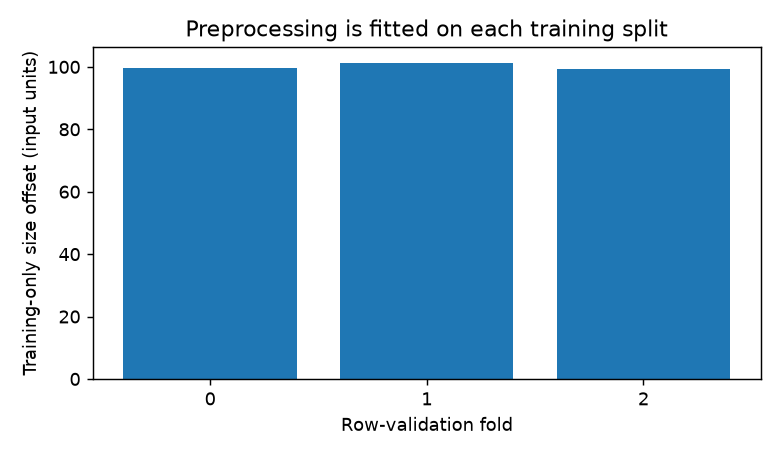
Executed source
"""Fit, search, project and reconstruct a missing-aware mixed-data Pipeline."""

from __future__ import annotations

import argparse
import json
from pathlib import Path

import numpy as np
from sklearn import config_context
from sklearn.model_selection import GridSearchCV, KFold, cross_validate
from sklearn.pipeline import Pipeline

from vbpca_py import VBPCA, AutoEncoder, ObservationMasker


def run_example(output="default"):
    """Run a bounded API example; eight iterations do not establish convergence.

    Returns:
        Input tables, fitted search, fold estimators and reconstructed new rows.

    Raises:
        RuntimeError: Scores or reconstruction violate the demonstrated contract.
    """
    rng = np.random.default_rng(23)
    raw = np.empty((36, 2), dtype=object)
    raw[:, 0] = np.tile(["west", "east", "north"], 12)
    raw[:, 1] = rng.normal(100, 5, len(raw))
    mask = rng.random(raw.shape) > 0.1
    raw[4, 1], raw[5, 0] = np.nan, np.nan
    mask[4, 1], mask[5, 0] = True, True
    data = np.where(mask, raw, "unobserved placeholder")
    new_data = np.array(
        [
            ["west", 90.0],
            ["unobserved placeholder", np.nan],
            ["north", "unobserved placeholder"],
            ["east", 115.0],
        ],
        dtype=object,
    )
    new_mask = np.array([[True, True], [False, True], [True, False], [True, True]])
    if output != "default":
        import pandas as pd

        data = pd.DataFrame(
            data,
            columns=["region", "size"],
            index=[f"train-{i}" for i in range(len(raw))],
        )
        new_data = pd.DataFrame(
            new_data,
            columns=data.columns,
            index=[f"new-{i}" for i in range(len(new_data))],
        )
    pipeline = Pipeline([
        ("observe", ObservationMasker()),
        (
            "encode",
            AutoEncoder(column_types=["categorical", "continuous"], binary="both"),
        ),
        (
            "model",
            VBPCA(
                1,
                maxiters=8,
                niter_broadprior=0,
                verbose=0,
                random_state=23,
                num_cpu=1,
                runtime_tuning="off",
            ),
        ),
    ])
    if output != "default":
        pipeline.set_output(transform=output)
        if output == "polars":
            # Raw object observations stay in pandas; numerical output uses Polars.
            pipeline.named_steps["observe"].set_output(transform="pandas")
    splitter = KFold(n_splits=3, shuffle=True, random_state=23)
    with config_context(enable_metadata_routing=True):
        result = cross_validate(
            pipeline,
            data,
            cv=splitter,
            params={"observation_mask": mask},
            error_score="raise",
            return_estimator=True,
        )
        search = GridSearchCV(
            pipeline, {"model__n_components": [0, 1]}, cv=splitter, error_score="raise"
        ).fit(data, observation_mask=mask)
        fitted = search.best_estimator_
        projected = fitted.transform(new_data, observation_mask=new_mask)
        # The masker has no inverse. Reverse the fitted model and encoder only.
        reconstructed = fitted[1:].inverse_transform(projected)
    if not np.isfinite(result["test_score"]).all():
        raise RuntimeError("The synthetic CV example returned a nonfinite score")
    if projected.shape != (len(new_data), search.best_params_["model__n_components"]):
        raise RuntimeError("The synthetic projection has the wrong shape")
    if reconstructed.shape != new_data.shape:
        raise RuntimeError("Reconstruction must use the original variable layout")
    if not np.isfinite(reconstructed[:, 1].astype(float)).all():
        raise RuntimeError("Reconstructed continuous values must be finite")
    return {
        "data": data,
        "mask": mask,
        "new_data": new_data,
        "new_mask": new_mask,
        "pipeline": pipeline,
        "splitter": splitter,
        "cv": result,
        "search": search,
        "projected": projected,
        "reconstructed": reconstructed,
    }


def export_gallery(result, output_dir):
    """Render learned fold offsets and original-unit reconstruction summaries."""
    import matplotlib.pyplot as plt

    fitted = result["search"].best_estimator_
    encoder = fitted.named_steps["encode"]
    schema = encoder.encoding_schema_
    schema.validate(len(encoder.get_feature_names_out()), strict_numeric=True)
    offsets = [
        fold.named_steps["encode"].encoding_schema_.variables[1].offset[0]
        for fold in result["cv"]["estimator"]
    ]
    fig, ax = plt.subplots(figsize=(6, 3.5))
    ax.bar(range(len(offsets)), offsets)
    ax.set(
        xlabel="Row-validation fold",
        ylabel="Training-only size offset (input units)",
        xticks=range(len(offsets)),
        title="Preprocessing is fitted on each training split",
    )
    fig.tight_layout()
    output_dir.mkdir(parents=True, exist_ok=True)
    fig.savefig(output_dir / "pipeline.png", dpi=130)
    plt.close(fig)
    summary = {
        "training_shape": list(result["data"].shape),
        "new_rows": len(result["new_data"]),
        "encoded_features": encoder.get_feature_names_out().tolist(),
        "schema_kinds": [v.kind for v in schema.variables],
        "fold_training_offsets": offsets,
        "selected_capacity": result["search"].best_params_["model__n_components"],
        "decoded_size_input_units": result["reconstructed"][:, 1]
        .astype(float)
        .tolist(),
    }
    (output_dir / "summary.json").write_text(json.dumps(summary, indent=2) + "\n")


def main() -> None:
    parser = argparse.ArgumentParser(description=__doc__)
    parser.add_argument(
        "--output", choices=["default", "pandas", "polars"], default="default"
    )
    parser.add_argument("--output-dir", type=Path)
    args = parser.parse_args()
    result = run_example(args.output)
    fitted = result["search"].best_estimator_
    print(
        "Encoded features:",
        fitted.named_steps["encode"].get_feature_names_out().tolist(),
    )
    print("Selected capacity:", result["search"].best_params_["model__n_components"])
    print("Conditional score shape:", result["projected"].shape)
    print("Reconstructed rows (region, size):")
    print(result["reconstructed"])
    print("Masked Pipeline, row CV, GridSearchCV and new-row projection passed")
    if args.output_dir is not None:
        export_gallery(result, args.output_dir)


if __name__ == "__main__":
    main()