Sparse observations and stored zeros
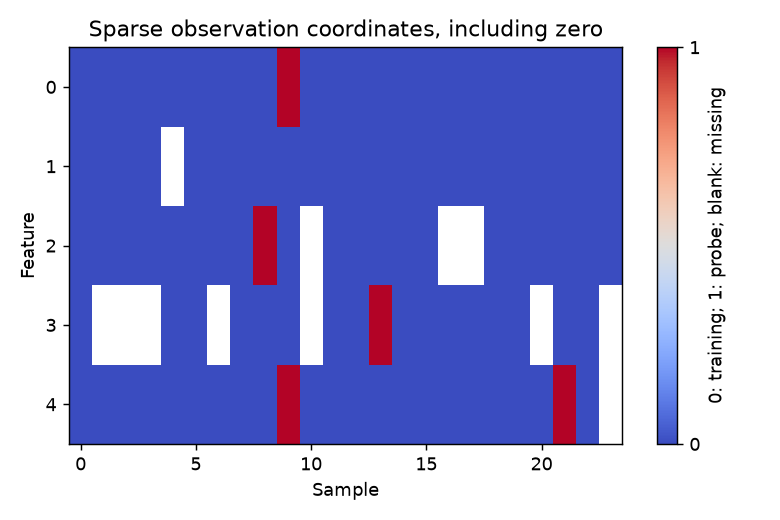
Blank cells are missing. Both training and probe coordinates retain measured zeros. The tiny dense reference uses the identical observation pattern.
These synthetic examples run at most eight fit iterations. They demonstrate API behavior; they do not establish posterior convergence, calibration or a recommended capacity.
This example uses the 0.5 API with the plot extra. From a matching source checkout, install python -m pip install '.[plot]', then run python scripts/gallery_sparse.py --output-dir outputs. The downloaded source can also run directly against that installed 0.5 build.
Download this standalone source.
Output
{
  "shape": [
    24,
    5
  ],
  "input_observations": 108,
  "training_observations": 103,
  "probe_observations": 5,
  "stored_observed_zeros": 1,
  "dense_reference_agrees": true
}
Executed source
"""Retain observed sparse zeros when splitting probes and fitting native PCA."""

import argparse
import json
from pathlib import Path

import matplotlib.pyplot as plt
import numpy as np
from scipy.sparse import csr_matrix

from vbpca_py import VBPCA, make_xprobe_mask


def run_example(output_dir):
    rng = np.random.default_rng(25)
    values = rng.normal(size=(24, 5))
    values[0, 0] = 0.0
    observed = rng.random(values.shape) > 0.2
    observed[:, 0], observed[0, :] = True, True
    rows, cols = np.nonzero(observed)
    sparse = csr_matrix((values[rows, cols], (rows, cols)), shape=values.shape)
    train, probe = make_xprobe_mask(sparse, 0.05, np.random.default_rng(19))
    np.testing.assert_equal(train.nnz + probe.nnz, sparse.nnz)
    np.testing.assert_equal(
        np.count_nonzero(train.data == 0) + np.count_nonzero(probe.data == 0), 1
    )
    options = {
        "maxiters": 8,
        "niter_broadprior": 0,
        "random_state": 25,
        "runtime_tuning": "off",
        "num_cpu": 1,
        "verbose": 0,
    }
    model = VBPCA(2, **options).fit(train, xprobe=probe)
    dense_probe = np.full(values.shape, np.nan)
    coordinates = probe.tocoo()
    dense_probe[coordinates.row, coordinates.col] = coordinates.data
    dense = VBPCA(2, **options).fit(
        np.where(observed, values, np.nan), xprobe=dense_probe
    )
    np.testing.assert_allclose(
        model.components_, dense.components_, rtol=2e-9, atol=2e-11
    )
    status = np.full(values.shape, np.nan)
    status[observed] = 0
    status[coordinates.row, coordinates.col] = 1
    fig, ax = plt.subplots(figsize=(6, 4))
    image = ax.imshow(
        status.T,
        aspect="auto",
        interpolation="nearest",
        cmap="coolwarm",
        vmin=0,
        vmax=1,
    )
    fig.colorbar(
        image, ax=ax, ticks=[0, 1], label="0: training; 1: probe; blank: missing"
    )
    ax.set(
        xlabel="Sample",
        ylabel="Feature",
        title="Sparse observation coordinates, including zero",
    )
    fig.tight_layout()
    output_dir.mkdir(parents=True, exist_ok=True)
    fig.savefig(output_dir / "sparse.png", dpi=130)
    plt.close(fig)
    summary = {
        "shape": list(sparse.shape),
        "input_observations": sparse.nnz,
        "training_observations": train.nnz,
        "probe_observations": probe.nnz,
        "stored_observed_zeros": 1,
        "dense_reference_agrees": True,
    }
    (output_dir / "summary.json").write_text(json.dumps(summary, indent=2) + "\n")
    print(json.dumps(summary, indent=2))


if __name__ == "__main__":
    parser = argparse.ArgumentParser(description=__doc__)
    parser.add_argument("--output-dir", type=Path, required=True)
    run_example(parser.parse_args().output_dir)